
What Is a Cold Roof? Construction, Costs & Why UK Roofers Are Phasing Them Out
The 60-second answer: A cold roof is a flat-roof or pitched-roof construction where insulation sits between or below the joists, with a continuous ventilated air gap above the insulation. The deck and joists end up on the cold side of the insulation.
SIX THINGS, EVERY JOB
What you get with Eco Roofers






What we typically see on Nottinghamshire roofs
Nottinghamshire roof-stock splits roughly into Victorian + Edwardian terrace in central Nottingham (NG1, NG3, NG7), inter-war and post-war semis through Mapperley/Sherwood and the West Bridgford suburbs, ex-coalfield estates around Mansfield (NG18-NG20) and Worksop (S80-S81), plus pantile-and-stone period property in Newark and the Trent-valley villages.
Local weather notes. The county catches Trent-valley weather — fewer high-wind events than the Pennines but more sustained-saturation rainfall in extended wet spells. South-westerly storms strip tile fixings on the same nailing line.
Approved Document L 2022 sets the thermal performance baseline for new roofs (U ≤ 0.16 W/m²K pitched, ≤ 0.18 flat). On flat roofs, BS 6229:2018 sets the design and falls standard. Eco Roofers will guide you through any Building Control notification needed on your job.
Get a free estimate for roofing in What Is a Cold Roof? Construction, Costs & Why UK Roofers Are Phasing Them Out
Enter your postcode and one line about your roof. Sean replies within 24 hours with a written quote.
What will my new roof cost?
Pick your property type and material. Get a typical UK 2026 cost range in seconds — no email required to see the number.
Market-typical UK 2026 ranges. Eco Roofers’ actual quote is built from a free 30-min on-site survey and delivered in writing within 24 hours, including VAT. 25% deposit, balance on satisfactory completion.
Cold roof anatomy — top to bottom
Working from outside (top) to inside (bottom):
1. Waterproof membrane — typically torch-on felt on older cold roofs; EPDM on more modern ones
2. Structural deck — OSB, plywood, or concrete (now on the cold side)
3. Continuous ventilated air space — minimum 50 mm, must run unobstructed from one eaves to the other
4. Joists with insulation between them — typically mineral wool or glass-fibre batts
5. Vapour control layer — to slow indoor moisture migration
6. Plasterboard ceiling inside the property below
The defining feature: the insulation is below the deck, so the deck and joists are cold. Without continuous ventilation, indoor moisture will condense on those cold timber surfaces.
Why cold roofs need ventilation
Indoor air is warmer and more humid than outdoor air (cooking, showering, breathing add roughly 14 litres of moisture a day to a family of four). That moisture rises. Without an escape path, it will hit the cold deck above the insulation and condense to liquid water — causing black mould on ceilings, rotted joists, and structural decay within 1–2 winters.
The “fix” in the cold-roof system is to keep the air space above the insulation continuously ventilated — eaves vents at one side, a continuous unobstructed run across the roof, and exit vents (eaves or ridge) at the other side. This sweeps moist air out before it can condense.
Why UK roofers are phasing cold roofs out
Three reasons, all from real-world failures we see across Nottinghamshire and South Yorkshire:
1. Ventilation almost never stays continuous. Birds nest in eaves vents. Insulation packs the air gap when fitted by amateurs. Builders block vents on extensions without realising. The system fails silently — often unnoticed for 5+ winters until the ceiling starts staining.
2. Modern airtightness makes condensation worse. Houses are tighter today than in the 1970s and 1980s. More moisture stays indoors and rises into the roof. A cold roof that worked in a draughty 1970s house leaks moisture catastrophically in a 2022 retrofitted house.
3. Building Regs no longer treat cold roofs as equivalent. Approved Document L 2022 effectively requires warm-roof construction for new flat roofs and major refurbishments. Cold roofs are tolerated only as a last-resort variation with specific structural justification.
When cold roofs still make sense
There are still valid scenarios for a cold-roof retain or fit:
- Tiny patch repairs on an otherwise-fine cold roof (matching what’s there)
- Listed buildings where conservation consent rules out raising the roof line by 150 mm
- Tight headroom situations where the ceiling can’t drop and the roof can’t rise
- Pitched-roof loft spaces where the cold-roof model still works because of a steeper ventilation path
In every other UK domestic flat-roof scenario in 2026, warm roof is the answer.
How to know if your roof is a cold roof
Three quick checks:
1. Look at the eaves. Continuous slotted soffit vents or round black ventilator caps spaced a few feet apart almost certainly means cold roof.
2. Check the loft / roof space. If you can see daylight between rafters and the underside of the deck, with insulation between the joists below, that’s a cold roof.
3. Look for a ‘flat’ roof line. Cold roofs sit at the original roof line height — no perimeter upstand bump. Warm roofs sit ~150mm higher.
If you have a cold roof and you’re seeing damp patches, black mould, or peeling paint on the ceiling below — see our Cold Roof Condensation Problems guide for the diagnostic.
Cold roof to warm roof conversion costs
For a typical 20 m² rear-extension cold roof, converting to a warm roof retrofit costs:
- £2,400–£4,500 fitted — strip the old membrane, lay 100–150mm PIR insulation over the existing deck, fit new EPDM or GRP membrane, dress upstands.
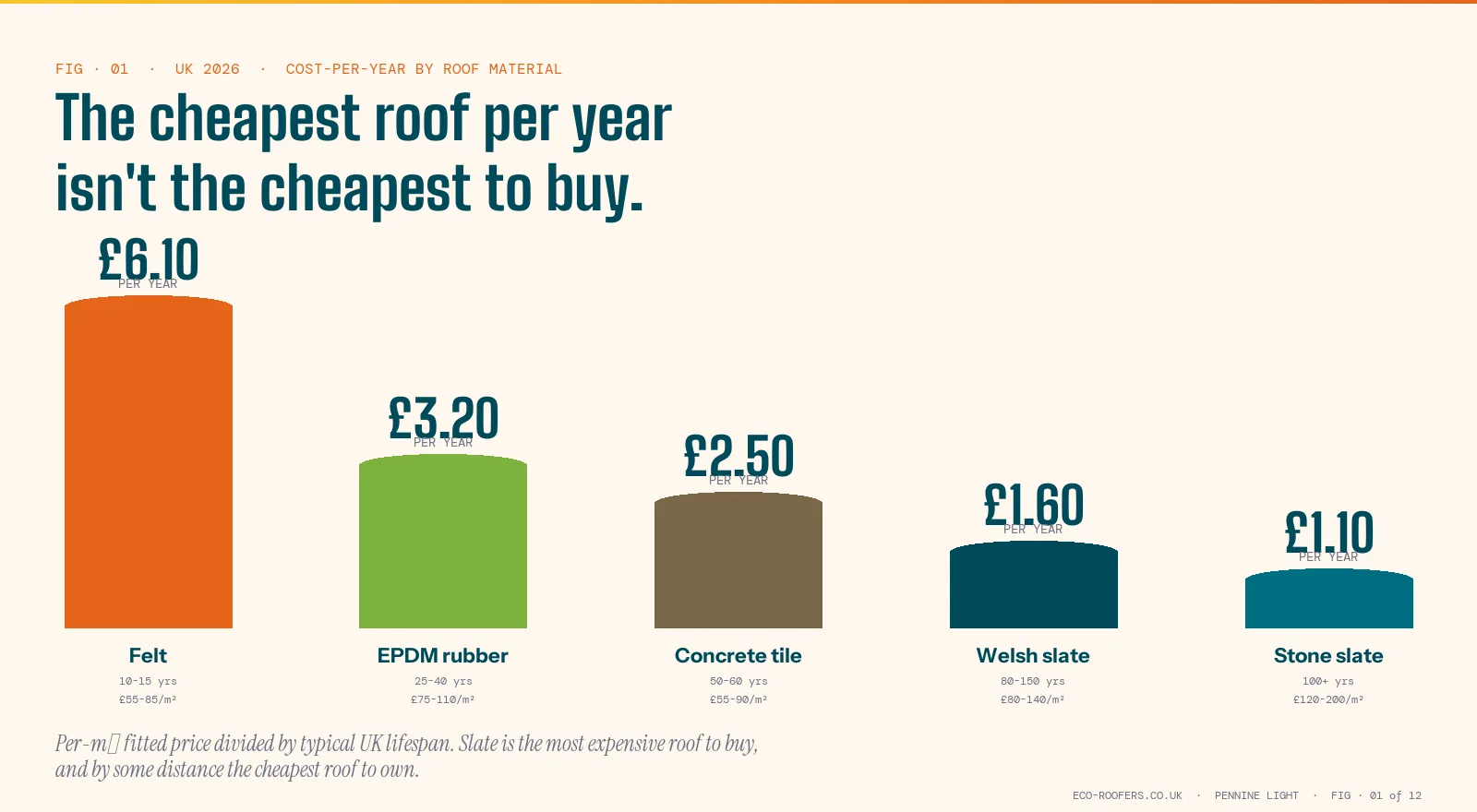
This compares to £1,500–£2,400 for a like-for-like cold-roof felt replacement. The £600–£1,200 premium for warm-roof retrofit pays back within 5–8 years on energy bills alone, and you eliminate the condensation problem permanently.
FAQ
Why are cold roofs being phased out?
Modern airtight UK homes generate too much indoor moisture for the cold-roof ventilation strategy to handle reliably. Once ventilation fails (which it usually does within 5–10 years), you get condensation, mould, and rot. Building Regs have responded by effectively requiring warm-roof construction for new builds and major refurbs.
Can a cold roof still be Building Regs compliant?
Yes, but it’s increasingly difficult. You need (a) demonstrably continuous and unobstructed ventilation, (b) a properly-detailed vapour control layer, and (c) sufficient insulation depth between joists to hit the U-value requirement of 0.18 W/m²K — that’s tough in a typical 100-200mm joist depth, especially after the air gap is taken out.
How do I know if my flat roof is cold or warm?
See the three checks above. The fastest tell: continuous eaves vents = cold roof. No vents and a 150mm upstand around the perimeter = warm roof retrofit.
What does it cost to convert a cold roof to a warm roof?
£2,400–£4,500 for a typical 20m² rear extension in Notts/South Yorks. Pays back in 5–8 years on energy savings alone. Eliminates condensation permanently.
Need to convert a cold roof to a warm roof?
Eco Roofers does cold-to-warm conversions across Nottingham, Mansfield, Sheffield, Doncaster, Chesterfield, Barnsley, Rotherham, Worksop, Newark and surrounding areas.
Phone 07929 379 746 or email sean@eco-roofers.co.uk for a free site visit. Written quote within 48 hours. 10-year installation guarantee.
 REF · CTA-01