
Types of Flat Roof Systems: Warm, Inverted, Cold & Uninsulated (UK Guide)
The 60-second answer: BS 6229 defines four UK flat-roof types: a warm roof (insulation above deck), an inverted warm roof (insulation above membrane, ballast above), a cold roof (insulation between joists with ventilated air space above), and an uninsulated roof (membrane on bare
SIX THINGS, EVERY JOB
What you get with Eco Roofers





What we typically see on Greater Manchester roofs
Greater Manchester roof-stock combines dense Victorian terrace (M14/M16/M21 — Rusholme, Whalley Range, Chorlton), inter-war semis through Didsbury and Withington, post-war estates through Wythenshawe and Salford, plus stone-slate cottage stock through the Oldham/Rochdale Pennine fringe.
Local weather notes. Wet-Atlantic weather means moss growth is markedly worse than the East Midlands — valley leaks and lead-flashing failure are more common.
Approved Document L 2022 sets the thermal performance baseline for new roofs (U ≤ 0.16 W/m²K pitched, ≤ 0.18 flat). On flat roofs, BS 6229:2018 sets the design and falls standard. Eco Roofers will guide you through any Building Control notification needed on your job.
Get a free estimate for roofing in Types of Flat Roof Systems: Warm, Inverted, Cold & Uninsulated (UK Guide)
Enter your postcode and one line about your roof. Sean replies within 24 hours with a written quote.
What will my new roof cost?
Pick your property type and material. Get a typical UK 2026 cost range in seconds — no email required to see the number.
Market-typical UK 2026 ranges. Eco Roofers’ actual quote is built from a free 30-min on-site survey and delivered in writing within 24 hours, including VAT. 25% deposit, balance on satisfactory completion.
The four BS 6229 types — at a glance
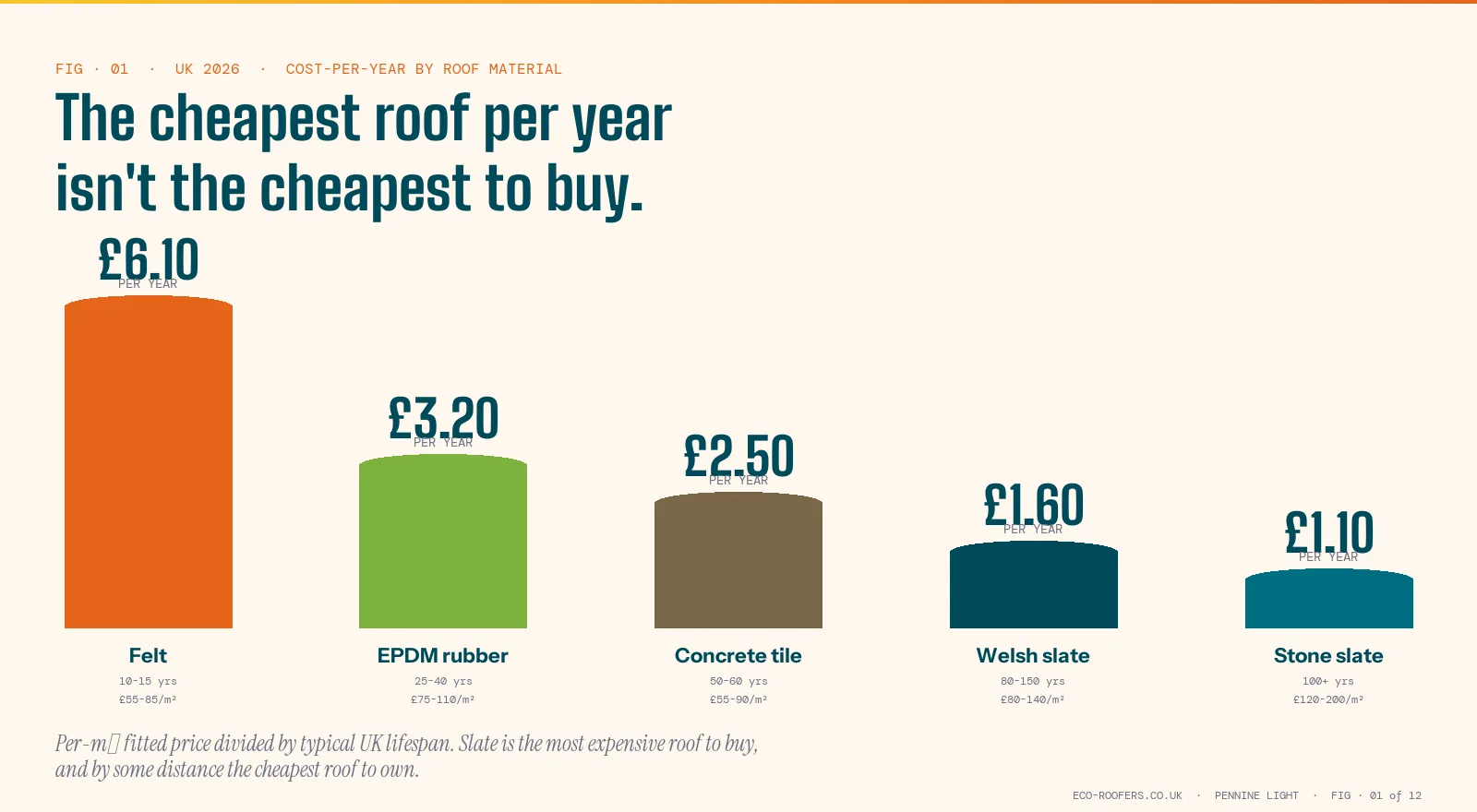
| Type | Insulation position | Condensation risk | Cost / m² | Lifespan | Where used |
|---|---|---|---|---|---|
| Warm roof | Above deck, beneath membrane | Very low | £80–£140 | 25–40 years | UK default — extensions, dormers, garages |
| Inverted warm | Above membrane, with ballast on top | Very low | £100–£160 | 25–40 years | Commercial, accessible flat roofs, green roofs |
| Cold roof | Between/below joists, vented above | High | £55–£85 | 15–25 years | Phasing out — special-case retrofit only |
| Uninsulated | None | N/A | £35–£60 | 10–20 years | Sheds, outbuildings, lean-tos |
How to identify yours
Three quick external visual checks (no ladder required):
1. Is there a 150mm ‘bump’ upstand around the perimeter?
- Yes → Warm roof retrofit (insulation above original deck pushed roof line up)
- No → cold roof, original-build warm roof, or uninsulated
2. Are there continuous slotted soffit vents or round black eaves caps under the roof overhang?
- Yes → almost certainly cold roof
- No → warm or uninsulated
3. Is there visible ballast (gravel, paving slabs, or a green-roof system) on top of the membrane?
- Yes → inverted warm roof
- No → standard warm or cold
Three internal visual checks (loft / roof space access required):
1. Can you see daylight between the rafters and the underside of the deck?
- Yes, with insulation visible between joists below → cold roof
- No, deck is fully covered → warm roof or uninsulated
2. Is there a vapour control layer (silver/aluminium foiled membrane) above the ceiling?
- Yes → warm roof (above deck VCL) or properly-detailed cold roof
- No → likely uninsulated or poorly-detailed cold roof
3. Are joists wet, stained, or showing black mould?
- Yes → cold roof with failing ventilation, or warm roof with failed VCL — get a survey
Pros and cons of each system
Warm roof
Pros: Best thermal performance, condensation-proof, Building Regs compliant by default, fitted from outside (no internal disruption), 25-40 year lifespan.
Cons: Higher upfront cost than cold roof. Raises roof line by ~150mm — possible issue under listed-building consent or where fascia geometry is fixed.
Inverted warm roof
Pros: Membrane fully UV-protected by ballast, longest membrane lifespan, accommodates green roof or roof-terrace surfacing, condensation-proof.
Cons: Heaviest of the four (structural load implications), higher cost, harder to inspect membrane (ballast obstructs view), more complex maintenance.
Cold roof
Pros: Cheapest to install, no roof-line raise, simplest joinery.
Cons: Condensation problems within 1-2 winters when ventilation fails (which it usually does), shorter lifespan, increasingly difficult to make Building Regs compliant for refurbishment, often flagged at survey.
Uninsulated roof
Pros: Cheapest, fastest to install, simplest detail.
Cons: No thermal performance — only suitable for unheated structures (sheds, outbuildings, garages without internal use).
Membrane options on each system
Each of the four roof types can take any of the standard UK membranes — but some combinations work better than others.
| Membrane | Warm roof | Inverted warm | Cold roof | Uninsulated |
|---|---|---|---|---|
| EPDM rubber | Default | ⚠️ Possible | Default | Default |
| GRP fibreglass | Excellent | No (ballast loads damage rigid laminate) | Possible | Excellent |
| Single-ply PVC | Default for commercial | Excellent | Possible | ⚠️ Overkill |
| Torch-on felt | ⚠️ Marginal — modern alternatives better | No | Default (legacy) | Common |
| Liquid applied (PU) | Excellent for complex shapes | ⚠️ Possible | Possible | Common |
| Mastic asphalt | ⚠️ Heavy — structural check | Common (with ballast) | ⚠️ Marginal | Common |
Cost comparison — fitted prices in Notts and South Yorks
Real ranges for typical jobs:
| Job | Warm roof | Cold roof | Inverted warm | Uninsulated |
|---|---|---|---|---|
| 12 m² garage roof | £900–£1,800 | £700–£1,200 | £1,200–£2,000 | £450–£800 |
| 20 m² extension flat roof | £2,400–£4,500 | £1,500–£2,400 | £3,000–£5,500 | £900–£1,500 |
| 50 m² larger extension | £6,000–£10,000 | £3,500–£6,000 | £7,500–£14,000 | £2,000–£3,500 |
For a typical UK domestic flat roof refurbishment in 2026, the warm-roof option is the right choice in 9 cases out of 10 — the cost premium over cold roof is paid back within 5–8 years on energy savings alone, and you eliminate the failure mode that causes most “5 years later, the ceiling is mouldy” problems.
Which type is the right choice for your situation?
You’re refurbishing a tired flat roof on an extension: Warm roof. Always.
You’re building a new extension: Warm roof. Building Regs require it.
You’re insulating a previously-uninsulated outbuilding to make it usable as a heated room: Warm roof retrofit.
You have a small commercial flat roof with foot traffic or roof terrace use: Inverted warm roof or warm roof with GRP membrane.
You’re patching 2 m² of an otherwise-fine 20 m² cold roof: Match what’s there (cold-roof patch).
You’re roofing a garden shed: Uninsulated. EPDM or torch-on felt straight on the deck.
You’re working on a listed building where roof-line height is constrained: Inverted warm roof (insulation goes on top of membrane, not below). Or carefully-detailed cold roof if conservation requires.
FAQ
What’s the difference between a warm roof and an inverted warm roof?
Insulation position relative to the membrane. Warm roof: insulation goes UNDER the membrane. Inverted warm roof: insulation goes OVER the membrane, held down by ballast.
Is an uninsulated roof ever acceptable?
Only on unheated structures — sheds, outbuildings, garages without internal use. Modern UK Building Regs require any heated space to be insulated to U ≤ 0.18 W/m²K.
Which type is cheapest?
Uninsulated, then cold roof. But on heated spaces those choices are usually false economies — uninsulated wastes energy, cold roof causes condensation. Lifetime cost on a heated extension favours warm roof.
Which type lasts longest?
Inverted warm roof, marginally — the membrane is fully UV-protected by ballast. Standard warm roof is essentially equivalent (25-40 year membrane life). Cold roof shortest because of the underlying condensation problem.
Need help choosing the right flat-roof system?
Eco Roofers covers Nottingham, Mansfield, Sheffield, Doncaster, Chesterfield, Barnsley, Rotherham, Worksop, Newark and the wider region. Free site visit, written quote, fixed price.
Phone 07929 379 746 or email sean@eco-roofers.co.uk. We’ll assess your existing roof, recommend the right system for your use, and give you a written quote within 48 hours. 10-year installation guarantee on every roof we install.
 REF · CTA-01